#12 THE WORLD WITHIN A CELL 8-21-26
We like to think we know what we are looking at. A tree is a tree. A rock is a rock. A human being is a human being. Our eyes give us a convincing picture of reality, but our eyes are remarkably limited instruments. There is an entire universe operating beneath the threshold of ordinary vision. The cell is one of the places where that hidden universe begins.
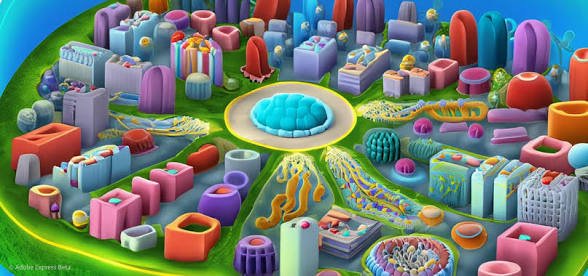
A human cell is extraordinarily small. Most cells cannot be seen with the unaided eye. Yet inside something so small that millions could fit into a space we barely notice, there is organization of astonishing complexity. There are membranes controlling what enters and leaves, structures producing energy, molecules carrying information, and countless chemical reactions occurring every moment. The cell is not simply a tiny bag of chemicals. It is an intricately ordered world.
“I will praise You, for I am fearfully and wonderfully made” (Psalm 139:14). David did not have a microscope. He could not see DNA, mitochondria, chromosomes, or molecular machinery. But he understood something modern science continues to teach us: the deeper we look into creation, the more reason we have to marvel.
What can we see? With an ordinary microscope, we can begin to see the architecture of the cellular world. With more powerful instruments, we can examine structures far smaller than anything our eyes could distinguish. Fluorescent techniques can allow scientists to follow particular molecules. Modern imaging can reveal cellular processes occurring in real time.
But every improvement in our ability to see also reveals how much remains unseen.
The deeper we look, the smaller the structures become. Molecules are composed of atoms. Atoms contain smaller components. And at the subatomic level, our ordinary idea of “seeing” begins to break down. We do not simply look at an electron the way we look at a grain of sand. We infer its properties through measurements and their effects.
That ought to produce humility.
We are surrounded by realities we cannot see. We cannot see gravity itself, but we see what gravity does. We cannot see radio waves with our eyes, but we can measure and use them. We cannot see every molecular event occurring inside a living cell, but we can observe its effects.
The Christian understands this principle spiritually as well. “For we walk by faith, not by sight” (2 Corinthians 5:7). Faith is not pretending that evidence does not exist. It is recognizing that visible reality is not the whole of reality. “The things which are seen are temporary, but the things which are not seen are eternal” (2 Corinthians 4:18).
The cell proves that invisible does not mean imaginary.
Inside that microscopic world is information, order, communication, energy production, transportation, repair, and reproduction. We cannot watch every event with our eyes, but we can study the evidence and understand what is happening.
And then we come to the great question: What can we know?
Science has discovered an enormous amount about the cell. We know that DNA contains biological information. We know that proteins perform specific functions. We know that cellular structures interact in remarkably precise ways. We know that energy is transformed and transported. We know that cells communicate with one another.
But science also teaches us what we cannot know completely. We cannot observe every event that has ever occurred inside every cell. We cannot reconstruct every molecular interaction in the history of a human body. There are limits to measurement, observation, prediction, and human understanding.
That should not discourage us. It should humble us.
“There is no searching of His understanding” (Isaiah 40:28). Our knowledge grows, but God’s knowledge is not growing. We discover things. God already knows them. We explore creation. God made it.
Think about that the next time you look at your own hand.
You see skin. God sees an extraordinary living system composed of countless cells, each containing structures and processes beyond what your eyes can perceive. You see a human body. God sees every molecule within it. You see the surface. He knows the depths.
The Psalmist asked, “How precious also are Your thoughts to me, O God! How great is the sum of them!” (Psalm 139:17). The wonder of the microscopic world should not merely make us admire nature. It should turn our attention toward the Creator.
The telescope teaches us humility by showing us how immense the universe is. The microscope teaches us humility by showing us how intricate the small is. We can look outward and be overwhelmed by galaxies. We can look inward and be overwhelmed by cells. In both directions, we encounter a creation far greater than ourselves.
And the Christian has one more reason to marvel.
The God who made the universe took on flesh.
The One who created the microscopic machinery of the human body entered a human body. The One who made life came into the world as a living man. “The Word became flesh and dwelt among us” (John 1:14).
That is greater than anything a microscope can reveal.
So study the cell. Explore the universe. Ask questions. Discover what can be discovered. But when your discoveries make you realize how little you know, do not despair. Worship.
What we can see should produce wonder.
What we cannot see should produce humility.
What we can know should produce gratitude.
And what we cannot know should remind us that we are creatures standing before a Creator whose wisdom is infinitely greater than our own.
“The heavens declare the glory of God; and the firmament shows His handiwork” (Psalm 19:1).
Sometimes the best place to see His glory is not in the heavens above us, but in the tiny world within us.
______________
Lord, open our eyes to the wonder of Your creation. Give us minds that love truth, hearts that remain humble, and wisdom to recognize Your handiwork in both the vastness of the universe and the smallest details of life. When we discover how much we do not know, remind us that You know all things. And may every discovery lead us beyond creation to the Creator. Amen.
BDD